National Strategic Plan
NSP Overview
In 2008, the Early Childhood Commission (ECC) supported the implementation of the Government of Jamaica’s first National Strategic Plan (NSP) for Early Childhood Development (ECD) (2008-2013). This plan served as a roadmap for improving the quality of ECD in the country and set the tone for all subsequent plans. The NSP for ECD is a five-year plan which takes into consideration all areas of early childhood development, guided by strategic priorities.Building on the successes of the first NSP, a second NSP for ECD (2013-2018) was developed. This plan guided the ECC in its role of regulating and coordinating the sector, creating lasting improvements for the young children of Jamaica.
The third NSP for ECD (2018–2023) further strengthened the foundations laid by the two previous NSPs, enabling the ECC it to fulfil its regulatory and coordinating mandate. This plan also emphasized greater partnerships and the need to clarify roles and responsibilities among stakeholders within the ECD sector.
The ECD sector has seen significant shifts since the implementation of the previous NSPs (2008-2013, 2013-2018 and 2018-2023) demonstrating the impact of these sequential plans. Key developments include the growth of the sector, major investments from local and international donors, increased support for parents and early childhood practitioners, and the sustained support of the government. As a result of these efforts, Jamaica leads the region in improvements in ECD.
In 2008, the Early Childhood Commission (ECC) supported the implementation of the Government of Jamaica’s first National Strategic Plan (NSP) for Early Childhood Development (ECD) (2008-2013). This plan served as a roadmap for improving the quality of ECD in the country and set the tone for all subsequent plans. The NSP for ECD is a five-year plan which takes into consideration all areas of early childhood development, guided by strategic priorities.
Building on the successes of the first NSP, a second NSP for ECD (2013-2018) was developed. This plan guided the ECC in its role of regulating and coordinating the sector, creating lasting improvements for the young children of Jamaica.
The third NSP for ECD (2018–2023) further strengthened the foundations laid by the two previous NSPs, enabling the ECC it to fulfil its regulatory and coordinating mandate. This plan also emphasized greater partnerships and the need to clarify roles and responsibilities among stakeholders within the ECD sector.
The ECD sector has seen significant shifts since the implementation of the previous NSPs (2008-2013, 2013-2018 and 2018-2023), demonstrating the impact of these sequential plans. Key developments include the growth of the sector, major investments from local and international donors, increased support for parents and early childhood practitioners, and the sustained support of the government. As a result of these efforts, Jamaica leads the region in improvements in ECD.
Currently, the ECC is implementing its fourth NSP for ECD (2023-2028). This plan utilizes a sector-wide, integrated approach for the development, implementation, monitoring and evaluation of ECD programmes in collaboration with ECC partners. Further to this, this plan introduces a new strategic priority, climate change. This addition signals the ECC’s recognition of global environmental changes and the need to foster climate awareness and sustainable development practices from an early age.
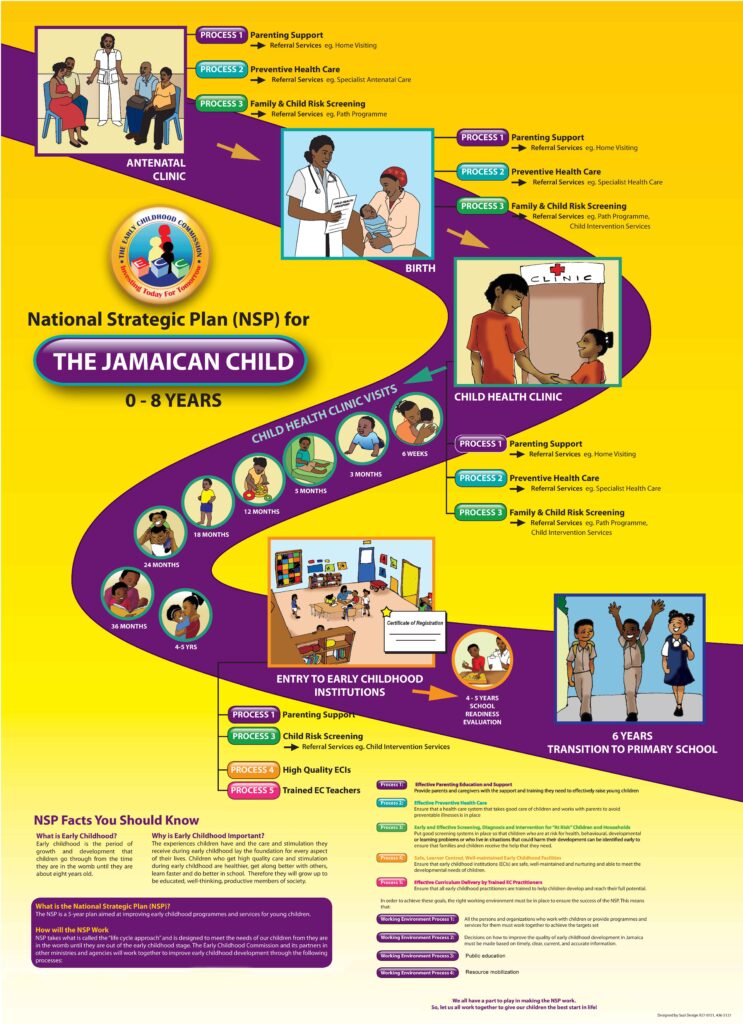
To achieve the transformation of the ECD sector, the NSPs for ECD are guided by the following strategic priorities:
- Effective Parenting Education and Support – Providing parents and caregivers with the
support and training they need to effectively raise young children. - Effective Preventive Healthcare – Ensuring a health system that takes good care of children and works with parents to avoid preventable illnesses is in place.
- Early and effective screening, diagnosis and intervention – Ensuring good screening systems are in place so that children who are at risk for health, behavioural, developmental or learning problems or who live in situations that could harm their development can be identified early.
- Safe, learner-centred, well-maintained ECIs – Ensuring that early childhood institutions are safe, well-maintained and nurturing and able to meet the developmental needs of children.
- Effective curriculum delivery by trained early childhood development practitioners –
Ensuring that all early childhood practitioners are trained to help children develop and
reach their full potential. - A coordinated approach to the delivery of ECD Services- Ensuring all individuals and
organizations who work with children or provide programmes and services for them
collaborate to achieve the targets set. - Evidence-based decision making – Ensuring decisions on how to improve the quality of ECD in Jamaica are made based on timely, clear, current and accurate information.
- Public Education – Providing the nation with information about the sector through
traditional and non-traditional media platforms. - Resource Mobilisation- Seeking donor partnerships to support ECD initiatives.
- Climate Change – Encouraging an awareness of climate change and sustainable development practices among our youngest citizens.